

Ship Revenue Cloud changes without breaking pricing, config, or approvals.
Built for Salesforce Revenue Cloud implementations from first rollout to every release after.
Capture a golden baseline, re-run it on every deploy, and catch pricing, configuration, and approval regressions before a bad deploy reaches production and quietly underprices your quotes.
Free workspace · No-code, self-serve setup · No credit card · SOC 2 Type II in progress
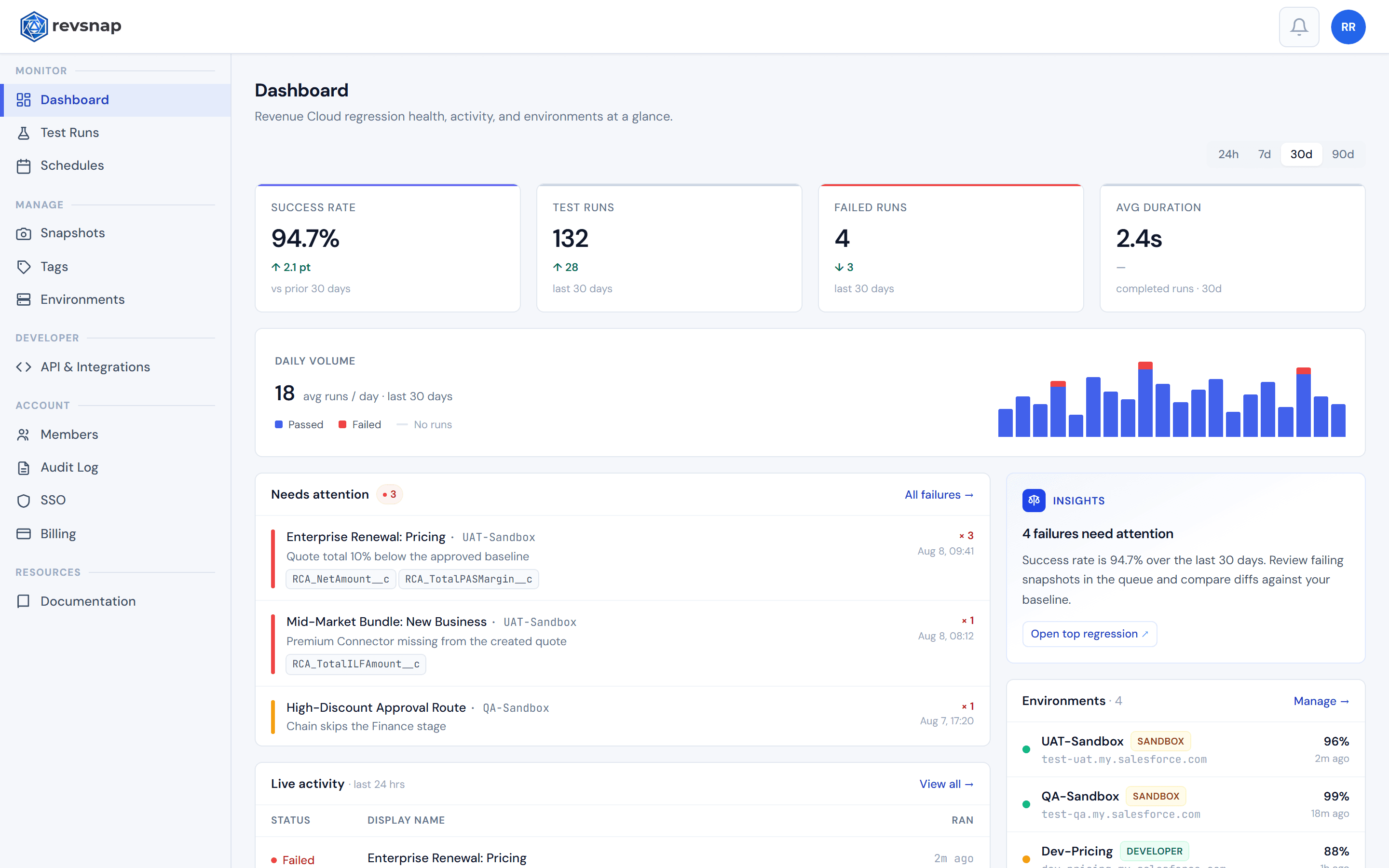
Your command center: regression health across every Revenue Cloud environment.
Enterprise-ready from day one
- SOC 2 Type II: in progress
- GDPR-ready DPA
- SSO & RBAC included
- Transparent sub-processors
Built by a Salesforce Revenue Cloud Technical Architect with 15+ years on the platform. Revsnap is the tool I wished existed on every implementation.
One command center for the whole revenue org.
For DevOps
A lightweight Node.js CLI, pull-request regression gates across pricing, config, and approvals, and deployment validation that drops into your existing pipeline.
For QA
No-code snapshot suites, scheduled runs across QA and UAT orgs, and clear diff viewers for pricing fields, configurator outcomes, and approval routing.
For RevOps
Lock down golden-master pricing, configuration rules, and approval paths. Ship metadata changes with confidence that quote-to-cash still works end to end.
Plugs into your pipeline
- GitHub Actions
- GitLab CI
- Copado
- Azure DevOps
- Jenkins
- Bitbucket Pipelines
- Salesforce CLI
Everywhere Revenue Cloud can silently break.
Pricing, configuration, and approvals are all metadata-driven and all regress the same way. Revsnap tests every one with the same capture → run → compare model.
Pricing testing
Prove pricing still calculates correctly.
Snapshot a validated quote and replay it on every deployment to prove pricing still calculates correctly.
- Bundle-aware, field-level diff with numeric tolerances
- Understands Context Definitions, Pricing Procedures & Expression Sets
- Catches Decision Table drift before a quote is issued
Configurator testing
Prove product configuration rules still fire.
Build proof scenarios that assert Product Configurator rules behave exactly as intended after a change.
- Auto-add, mutual exclusion, cardinality, quantity & attribute rules
- Single- or multi-rule scenarios in one snapshot, run rule by rule
- Live Scenario Proof Timeline with step-by-step pass/fail
Approvals testing
Prove Advanced Approvals still route correctly.
Capture an Advanced Approvals preview as a golden baseline, then re-run it to detect routing drift.
- Diffs chains, stages, levels, conditions & assignees
- Flags missing steps, wrong approvers & smart-approval drift
- Preview-only and same-org never submits or auto-approves
Why Revenue Cloud changes the regression game.
Pricing is no longer a database table. It's a metadata-driven engine and a single rule change can ripple across thousands of active quotes.
Legacy CPQ (Steelbrick)
Pricing was tightly coupled to the database.
- Object-driven price rules and discount schedules
- Validation through SOQL and record-level inspection
- Familiar testing patterns; predictable surface area
Salesforce Revenue Cloud
Pricing is a decoupled, metadata-driven engine.
- Context Definitions, Pricing Procedures & Expression Sets
- Decision Tables and Context Mappings orchestrate logic
- One rule edit can silently impact thousands of quotes
- Manual regression testing no longer scales
A day on Revenue Cloud
The changes that break revenue never look dangerous.
One Decision Table row just cost finance $180K.
An admin tweaks a single discount row. Three days later, 47 active quotes are underpriced by ~$180K. The change passed UAT. Nobody re-ran every pricing scenario by hand.
Two products that can’t coexist are suddenly sellable together.
A refactor to a bundle’s constraint rules quietly drops a mutual-exclusion rule. Reps start configuring an invalid combination that should never leave the configurator.
A high-discount quote skips Finance entirely.
An assignee remap changes who a chain routes to. Quotes that should stop at Finance now auto-advance, no error, no broken price, just a missing approver.
Stop gambling with your revenue engine.
Impossible Manual Regression
Re-validating every pricing, configuration, and approval path after a metadata change is slow, brittle, and lets critical bugs slip into production.
Costly Rework Cycles
Finding regressions late in UAT or worse, in production forces your team into expensive, repetitive validation loops.
High-Risk Deployments
Fear of breaking complex pricing rules, product configurations, or approval routing stalls innovation. Every release becomes a gamble on revenue.
Snap. Run. Compare.
Three steps to protect every Revenue Cloud deployment.
Snap
Capture a golden baseline pricing outputs, a configurator proof scenario, or an Advanced Approvals preview as an immutable, version-controlled snapshot.
Run
Re-run against your target org: pricing and configurator scenarios replay to force a fresh calculation; approvals re-check routing with a preview-only pass.
Compare
Get a clear pass/fail diff bundle-aware pricing fields, configurator rule outcomes, or approval routing with severity-ranked diagnostics on what changed and why.
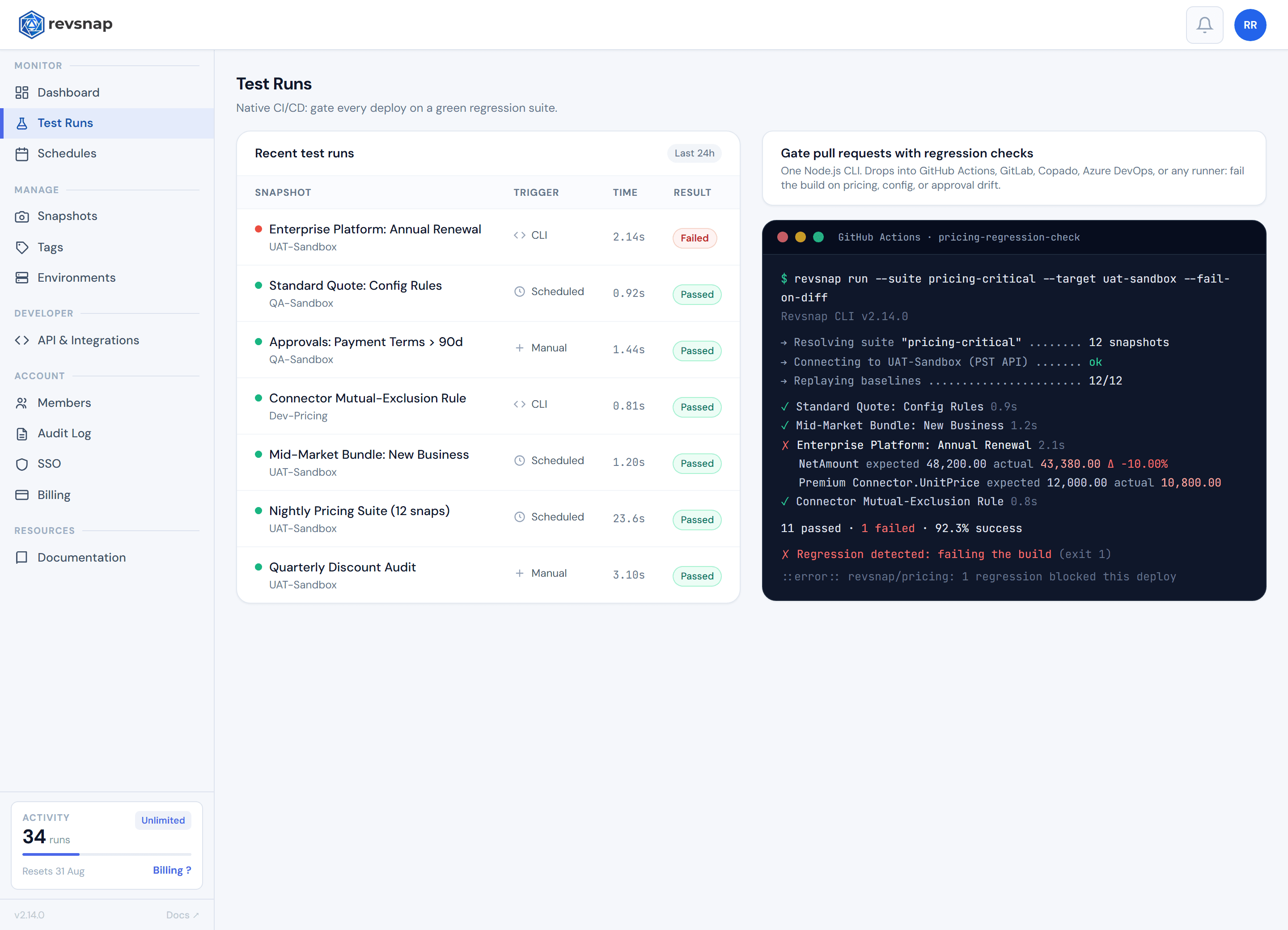
Capture golden baselines without writing a line of code.
Connect a trusted Salesforce org and snapshot what matters: full pricing outputs and bundle hierarchies, configurator proof scenarios, or an Advanced Approvals preview as a version-controlled baseline.
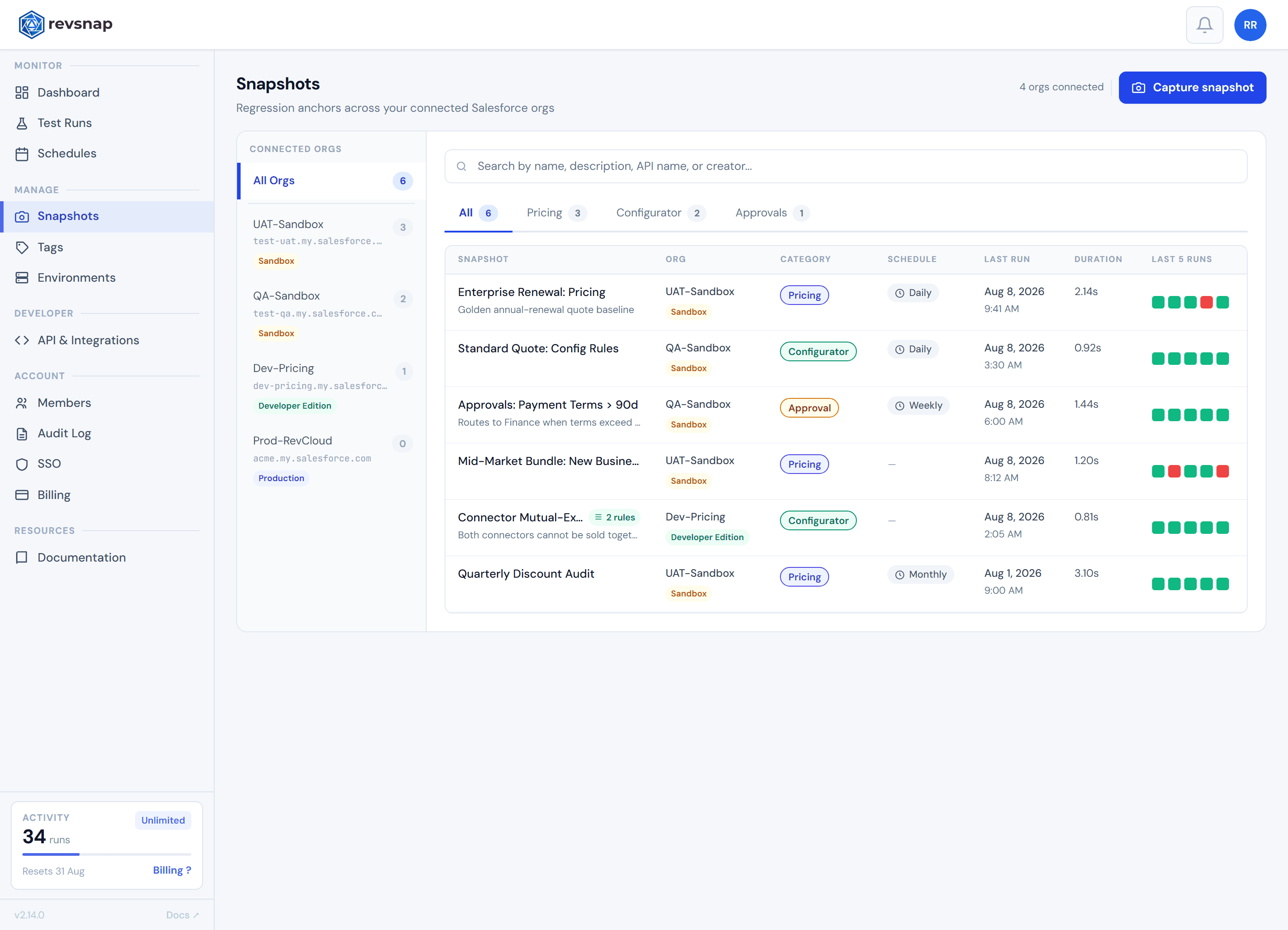
See exactly what changed: field by field.
Every run returns a clear pass/fail diff: bundle-aware pricing fields with numeric tolerances, configurator rule outcomes, or approval routing, with the exact variance on each mismatch, so you know precisely what broke and by how much before it ships.
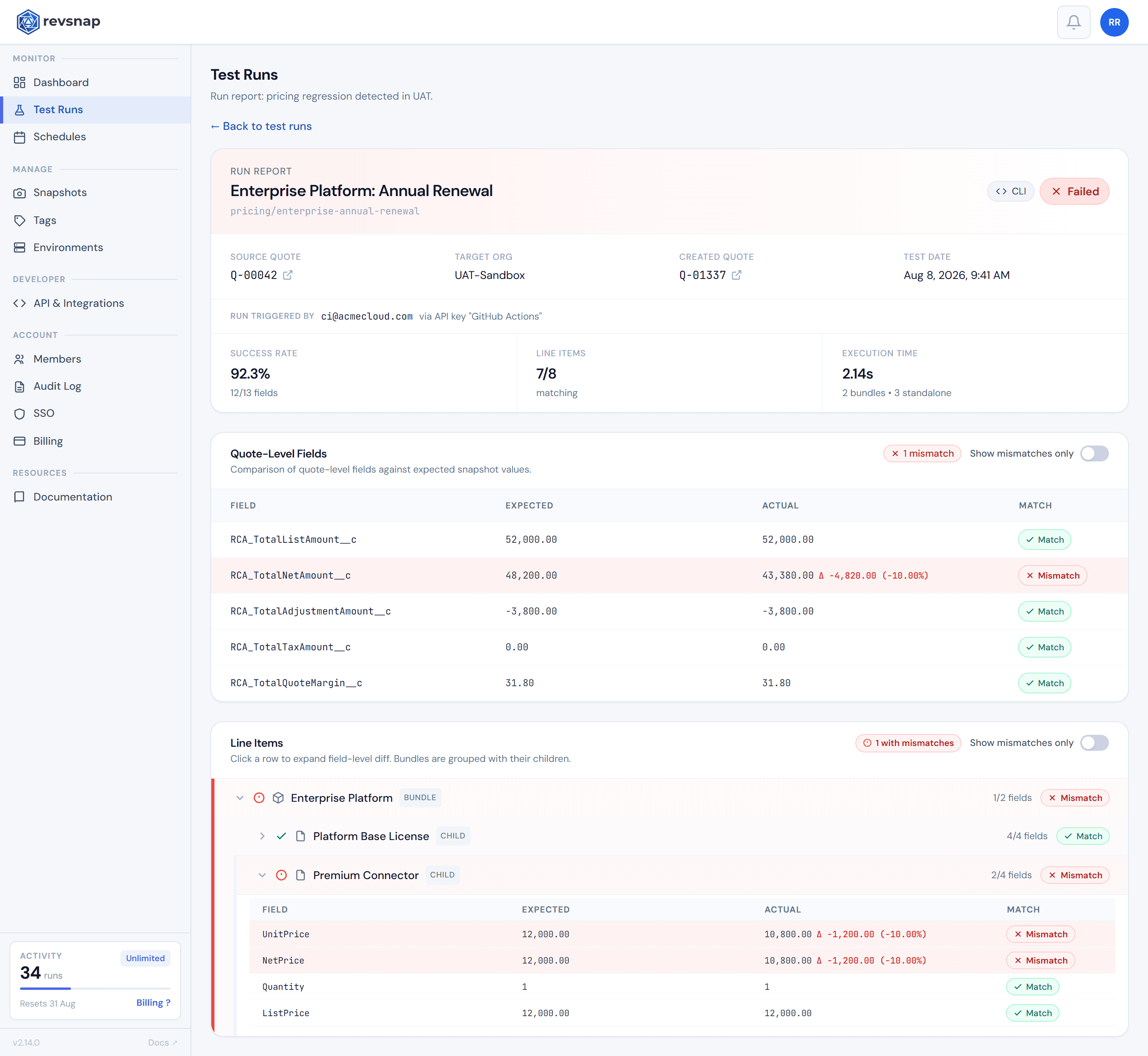
Native CI/CD: gate pull requests with regression checks.
Trigger full suites from a Node.js CLI, fail the build on pricing, configuration, or approval drift, and validate deployments before they promote. Integrates with GitHub Actions, GitLab, Copado, and any pipeline runner.
Why teams pick Revsnap over the alternatives.
Built for Revenue Cloud's metadata engine (pricing, configuration, and approvals), not adapted from a generic Salesforce UI test tool.
| Capability | Manual QA | UI Test ToolsProvar, Copado RT | Revsnap |
|---|---|---|---|
| Bundle-aware, field-level pricing diff | |||
| Proves Product Configurator rule outcomes | |||
| Regression-tests Advanced Approvals routing | |||
| Understands Expression Sets & Decision Tables | |||
| Multi-rule scenario snapshots | |||
| No flaky UI selectors | |||
| Tolerance-based numeric comparison | |||
| CI/CD gating via Node.js CLI | |||
| Scales to thousands of scenarios | |||
| Cross-sandbox replay (Dev → UAT) |
Comparison reflects Revsnap's product scope. Other tools listed are trademarks of their respective owners.
Built for the Enterprise. Designed for the Team.
Deploy with confidence knowing your data is protected by strict security controls.
Single Sign-On (SSO)
Role-Based Access Control (RBAC)
Immutable Audit Logs
Multi-Tenant Isolation
Procurement-ready governance.
Every policy your security and legal teams will ask for is published, versioned, and linkable.
Frequently asked questions.
How is Revsnap different from Provar, Copado Robotic Testing, or other Salesforce test tools?
What can Revsnap test, just pricing?
How does configurator testing work?
What does approvals testing check, and is it safe to run?
Does Revsnap write to my Salesforce org?
How does Revsnap connect to Salesforce?
Can I compare across sandboxes (capture in Dev, replay in UAT)?
Is there a free tier?
How does CI/CD integration work?
We're onboarding a small group of Revenue Cloud teams.
Join early and you get hands-on setup help capturing your first golden baselines, a direct line to the team, and real influence over what we build next. You'll be working directly with the person building Revsnap, a hands-on Revenue Cloud Technical Architect, not a support queue.
Eliminate pricing regressions.
Accelerate Revenue Cloud.
Join the RevOps, QA, and DevOps teams shipping Salesforce changes faster, and safer, than ever before.
Free workspace · No-code, self-serve setup · No credit card.